
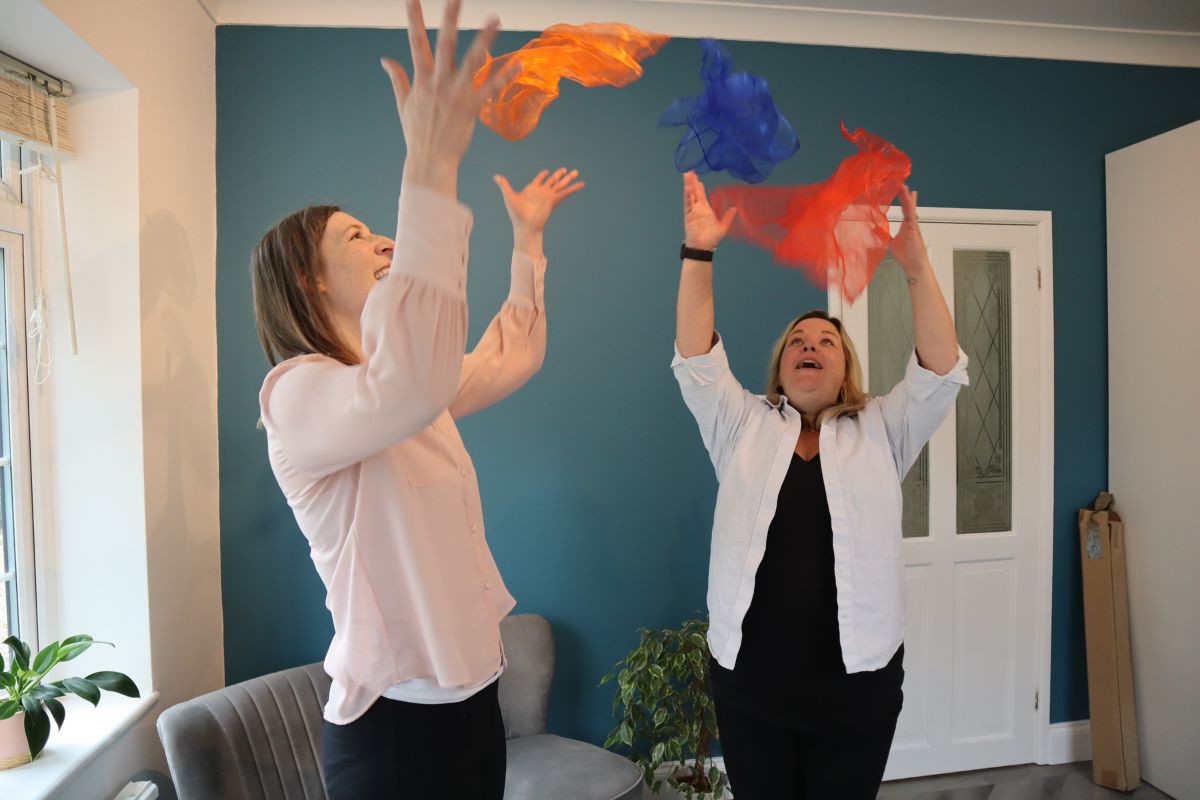
Have you ever wondered what a therapy session actually looks like? Let’s take you behind the scenes. One observation we often get is ‘but you’re just playing.’ It might look like just playing, but there’s a lot more going on.
You may also be asking, ‘what will my child actually do?’ The answer to this question – it probably looks different every time! This depends on your child’s age, their goals, what they’re interested in or how they’re feeling on the day. One session may be more structured, another may be on the floor, running round the garden or baking cakes. Good therapy isn’t about following a fixed plan of activities, it’s responsive. It’s about knowing your child so well, that you can adapt, accommodate and follow their lead. It’s about knowing why you’re doing what you’re doing.

What you see/What we see:
You might see a therapist decorating biscuits, playing in the water, filling and refilling, blowing bubbles or doing crafts. What is harder to see is that within this we are simultaneously working on attention, turn-taking, speech sounds, vocabulary, sentence structure, emotional understanding, confidence, self-advocacy or conversational skills.
You see: your child choosing what to play with. We see: motivation, an opportunity to follow their interests, joy and regulation.
You see: us playing in water. We see: opportunities for modelling new vocabulary, turn taking, making requests and comments, managing what happens when we get wet
You see: lots of repetition. We see: thought out practise opportunities to help new skills become easier and more spontaneous
You see: a therapist changing the activity halfway through. We see: us constantly assessing, adapting and responding to what your child needs that day.
You see: us chatting to you at the end of a session. We see: one of the most important parts of therapy: helping skills move beyond the therapy session and into everyday life.
Starting therapy can feel like a big step, but it doesn’t have to.
We recognise that starting therapy can feel huge. It can come with lots of questions, barriers and fears. We’re here for it! We are here for the highs, the lows and everything in between. We want you to feel confident and empowered to take this beyond the therapy session. So let’s tackle some of those common fears you may be experiencing.
“Does starting therapy mean something is wrong with my child?” No! Therapy is about understanding your child’s communication profile and giving them the right support, at the right time. Sometimes a child’s needs are more significant; sometimes they are just in a specific area of communication. Either way, getting advice early can make things feel clearer.
“Will my child be expected to sit at a table and ‘perform’?” As we said above, good therapy is responsive. Your sessions may involve movement, conversation, games, drawing, books or everyday classroom activities. We adapt to a child rather than expecting them to follow a rigid plan. Above all, sessions are always child led, strength and interest based with strong foundations of connection, regulation and joy. I don’t know about you, but sitting at a table being expected to ‘perform’ does not bring me joy!
“What if my child doesn’t talk to the therapist?” This is one we see all the time! Building trust and safety is a fundamental part of therapy. Observation, play and interaction can tell us a lot, even before a child feels ready to ‘communicate with us directly.
“What if my child refuses to join in?” Again, this is all information. We are thinking on our feet all the time and perhaps we need to adapt something. Is it not an activity that makes them tick? Change it!
“Will we be given lots of homework?” We always want therapy to fit into your family life. It has to work for you. Often the most useful strategies are the small changes to everyday routines. We also want you to feel empowered and confident to carry on between sessions, so we’ll ask you. What do you feel you can do?
“Will I be judged as a parent?” Some parents may worry that the reason behind their child’s speech, language or communication difficulties is something they’ve done wrong. Your child’s challenges are not a reflection of you. Therapy will always be collaborative, not about blame or judgement.
“Will the recommendations be impossible to fit into a busy classroom?” Schools are busy, we know this. Strategies and targets need to be realistic, manageable and integrated into what staff are already doing.
“Once we start therapy, are we signing up forever?” Therapy should always have a purpose. We are constantly monitoring, reviewing and adapting based on your child’s response and progress in sessions. Sometimes children need more intensive input, sometimes occasional monitoring, and sometimes a period without any direct therapy at all.
Things we wish you knew before starting your Speech and Language Therapy journey.
-You don’t need to prepare your child to behave perfectly.
-You don’t need to practise beforehand.
-You don’t need to know exactly what is wrong.
-Your child doesn’t have to talk to us immediately.
-You aren’t being assessed as a parent or teacher.
-And it’s absolutely fine to ask us questions.
Sometimes families and teachers can spend months wondering whether they should wait and see. Asking for advice doesn’t automatically mean a child needs long-term therapy; sometimes reassurance, assessment or a few practical strategies are exactly what is needed.
Therapy is not about finding what your child can’t do; it is about understanding what helps them communicate successfully.